
Prime Minister Narendra Modi met India's Asian Games medal-winners, including the gold-winning cricket teams, on Thursday. He praised their achievements, highlighting India's growing strength in sports and its ambition to become a credible host for major international events, including a bid for the 2036 Olympics. Modi also emphasised the government's support for athletes and urged medallists to mentor the next generation.

Former India all-rounder Irfan Pathan has advocated for Yashasvi Jaiswal to receive ample opportunities in the upcoming ODI series against the West Indies. Pathan believes this exposure is crucial for Jaiswal to establish himself as a backup opener for the next year's ODI World Cup. He also highlighted the importance of testing India's bench strength, especially with several key players participating in the Asian Games, and backed Naman Dhir's inclusion for his all-round capabilities.

Former Indian shooter Rajeshwari Kumari has been appointed as the South Asia representative to the Olympic Council of Asia's (OCA) Athletes Committee. Her nomination was approved by the OCA Executive Board, bypassing elections held for other zonal positions. This appointment highlights her continued involvement in sports administration following a successful shooting career and her family's legacy in Olympic sports.

'Work hard and have patience, because after long, hard work you achieve your target. Always stay disciplined, work hard and be passionate about your sport.'

The Indian men's cricket team has advanced to the Asian Games semi-final after their quarter-final match against Afghanistan was abandoned due to rain, with India progressing based on their superior ICC T20I ranking.

Hardik Pandya and Rishabh Pant were not picked in Indian team for the upcoming ODI series against the West Indies, while Ruturaj Gaikwad made a return to the one-day team.

Indian benchmark indices Sensex and Nifty rebounded on Wednesday, driven by a decline in crude oil prices below USD 100 per barrel and optimism surrounding a potential de-escalation of the conflict in West Asia.

We have to perform in both batting and bowling, Axar Patel says ahead of India's Asian Games 2026 cricket final against Pakistan on Saturday.

India has announced its 23-member squad for the upcoming AFC U20 Asian Cup Qualifiers in Tashkent, with eight players omitted from the initial camp. The team, led by Mahesh Gawali, will compete against Syria, Uzbekistan, and Bangladesh from August 31 to September 6, aiming for qualification to the main tournament in China in 2027.

Leg-spin all-rounder Vipraj Nigam has been named as the replacement for senior spinner Varun Chakravarthy in India's Asian Games cricket squad. Chakravarthy was ruled out due to a side strain, marking a setback after his recent return from injury. Nigam, a Delhi Capitals player, brings IPL experience to the team.

Typhoon Dujuan is approaching East Japan's Pacific Coast, bringing warnings of heavy rain, strong winds, and landslides. The typhoon has already caused transportation disruptions and led to the postponement of an equestrian event at the Asian Games venue.
The India U-20 men's football team has concluded its preparations for the AFC U20 Asian Cup China 2027 Qualifiers with an unbeaten run in four friendly matches, securing three wins and a draw without conceding any goals. The team is now heading to Uzbekistan for the crucial qualifiers, aiming for a strong performance.

'Elevated crude prices and unchanged domestic fuel prices would put pressure on the profitability and cash flows of OMCs.'

Marine war-risk premiums for West Asian shipping routes, particularly the Red Sea corridor, have surged by as much as 200 per cent due to renewed geopolitical tensions, with some high-risk transits seeing increases of over 1,000 per cent, according to industry brokers.

India defeated West Indies by eight wickets in the first T20I, powered by Shreyas Iyer's maiden T20I century and a dream debut performance from all-rounder Naman Dhir, who took three wickets. India successfully chased down the target of 172 with ease.

Shubman Gill scored the fastest double hundred in ODI history (223 not out) and Rohit Sharma added a century (101) as India chased down West Indies' formidable total of 405 for seven, securing an eight-wicket victory and sealing the series. This historic chase also marked India's highest-ever ODI run chase.

Sanju Samson discusses how the Indian cricket team is maintaining focus and team spirit despite incessant rains disrupting their training and matches in Japan ahead of the Asia Games semifinal. He highlights the team's constant meetings and gym sessions to stay "switched on" and ready for the crucial match against Sri Lanka, while also acknowledging the depth of Indian cricket talent.

VVS Laxman, BCCI's Centre of Excellence chief, will coach the Indian men's cricket team at the upcoming Asian Games 2026 in Aichi-Nagoya, Japan. He will be assisted by Sunil Joshi, Hrishikesh Kanitkar, and Subhadeep Ghosh. Gautam Gambhir, the regular head coach, will be with the senior team for the West Indies ODI series. Amol Muzumdar will continue as the head coach for the Indian women's team, who will also defend their title.

India's U20 football team, the Blue Colts, is set to kick off their AFC U20 Asian Cup China 2027 Qualifiers campaign against Syria in Tashkent. This opening match is crucial as India aims to secure their first-ever win against Syria and qualify for the Asian Cup for the first time since 2006, navigating a tough group that also includes Uzbekistan and Bangladesh.

Indian stock markets, including the Sensex and Nifty, experienced their third consecutive day of declines, driven by a global selloff, escalating tensions in West Asia, and a subsequent rise in crude oil prices.

Pakistan, Turkiye, and Saudi Arabia have signed a trilateral defence pact, agreeing to treat an attack on one as an attack on all. Analysts suggest this alliance could significantly diminish the United States' strategic influence in West Asia and elevate Pakistan's geopolitical standing, potentially acting as a deterrent in regional conflicts.

K L Rahul is likely to be named India's vice-captain for the upcoming three-match ODI series against the West Indies, starting on September 27.

India captain Shubman Gill and opener Shafali Verma have been named ICC Men's and Women's Player of the Month, respectively, for October. Gill received the award for the fifth time following his stellar performance in the ODI series against the West Indies, while Verma was recognised for her impressive show in the Asia Cup and Asian Games, marking her second win.

Indian benchmark indices, Sensex and Nifty, saw declines in early trade due to escalating crude oil prices and ongoing US-Iran hostilities, which subdued investor risk appetite.

Indian stock markets closed lower due to selling in IT and FMCG shares, triggered by renewed tensions in West Asia which led to a rally in crude oil prices and concerns over inflation and interest rates.

'We have a very demanding electorate which expects us to do something. So we will have to do something which is a bit out of the ordinary while at the same time keeping in mind the risk factors.'

US President Donald Trump has expressed strong support for the India-Middle East-Europe Economic Corridor (IMEEC), citing the necessity to move energy infrastructure away from Iranian checkpoints following attacks in West Asia. He made these remarks during a multilateral meeting with the Gulf Cooperation Council at the UN General Assembly, emphasising the corridor's role in overcoming regional challenges.

Chinese President Xi Jinping addressed the BRICS summit, urging the bloc to play a significant role in achieving peace and tranquillity in West Asia and the Gulf region. He highlighted BRICS' growth over two decades, its efforts in tackling global challenges, and its steadfastness in safeguarding the interests of the Global South. Xi called for opposing the Cold War mentality, strengthening multilateralism, and promoting cooperation in emerging domains like AI, as China prepares to chair the next summit.

'In the current environment, India is effectively paying a premium for supply security and diversification.'
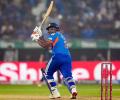
Former cricketer Cheteshwar Pujara believes the Indian team is well-prepared for the slowish tracks expected in the upcoming T20I series against the West Indies, particularly the first match in Lucknow, thanks to their recent experience on challenging pitches at the Asian Games in Japan.
Indian benchmark equity indices, Sensex and Nifty, experienced declines in early trade due to renewed tensions in West Asia, which led to a rebound in crude oil prices, coupled with weak global market trends and foreign fund outflows.

Indian skipper Shreyas Iyer has assured young talent Vaibhav Sooryavanshi that opportunities will come if he remains consistent, while also reflecting on India's high-scoring T20I series against West Indies, which ended in a 2-2 draw.

Indian benchmark indices, Sensex and Nifty, closed lower on Monday due to elevated crude oil prices, escalating US-Iran hostilities, and concerns over a potential US interest rate hike, impacting investor sentiment.

The benchmark Sensex plummeted 813 points to a three-month low, with the Nifty settling below 23,450, as escalating tensions in West Asia drove crude oil prices above USD 100 per barrel, leading to widespread selling in IT, FMCG, financial services, and oil & gas shares.

Former India spinner Pragyan Ojha has been appointed as the new chairman of the Indian men's cricket team's selection committee, with Ramesh Powar joining as a new selector.

Indian cricketers Shubman Gill, Abhishek Sharma, Sree Charani, and Shafali Verma have been shortlisted for the ICC Men's and Women's Player of the Month awards for September, recognising their exceptional performances in recent international matches.

India dropped teenage sensation Vaibhav Sooryavanshi despite his impressive Asian Games run, preferring Sanju Samson as Gautam Gambhir backed experience and resisted pressure to alter the winning combination.

Despite limited opportunities in the playing XI, India skipper Shreyas Iyer has expressed strong confidence in young cricketer Vaibhav Sooryavanshi, stating that the 15-year-old's time to dominate Indian cricket will come.

Shreyas Iyer has surged to a career-best seventh position in the ICC Men's T20I Batting Rankings after smashing his maiden T20I century in the opening match of the home series against the West Indies in Lucknow on Tuesday.

India's trade with West Asia saw a significant decline of over 28% in April, marking the second consecutive month of contraction. This downturn is attributed to severe shipping disruptions stemming from the ongoing conflict involving the US, Israel, and Iran, particularly impacting the crucial Strait of Hormuz waterway.
